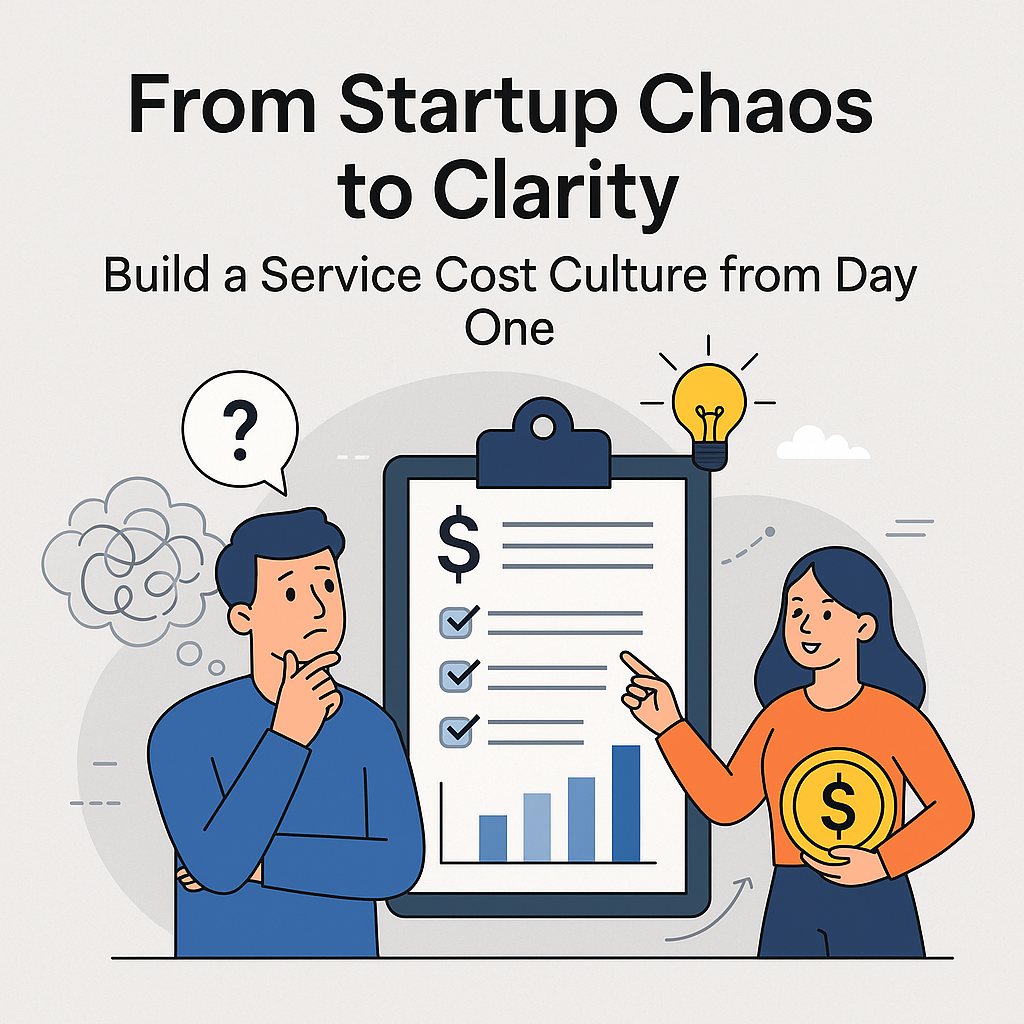
From Startup Chaos to Clarity: Build a Service Cost Culture from Day One

Most founders think cost control slows growth. It doesn’t – ignorance does.
The friction to start using a digital tool has collapsed to a single click. Swiping the corporate card feels frictionless, experimentation-friendly, and perfectly aligned with the “move fast” mantra. But every new trial, seat upgrade, or “temporary” license adds an invisible weight to the burn rate. Industry data shows that SaaS spend now averages $4 830 per employee, a 21.9 % jump in just one year (Zylo, 2025). Companies then discover that 53 % of those licenses sit idle within 30 days (CloudZero, 2025). By month three, that overhead erodes the agility founders pride themselves on, siphoning cash that could fund market experiments or buffer backend costs.
Here’s the contrarian take: discipline breeds speed. Money you don’t waste becomes runway you can invest back into product, hiring, or marketing. Waiting until “after product-market fit” to gain visibility is backward. Our point of view:
Most teams hunt cheaper tools, but the real win is knowing exactly where every euro already goes.
Picture an early-stage fintech in Lisbon. Ten engineers, two designers, one growth lead. A quick card export reveals 43 recurring subscriptions—nobody can say which projects still need half of them. That fuzziness isn’t just an accounting annoyance; it can threaten the 18-month runway investors believe you have.
Key Takeaways
- Early visibility extends runway without throttling product velocity.
- A 90-60-30 cadence (inventory in 90 days, renewal alerts 60 days out, 30-day reviews) beats heavyweight procurement processes.
- Startups that track spend from Day 1 save up to 30 % on SaaS within 12 months (Torii, 2025).
- Cost culture builds investor confidence for future rounds.
Why Startups Avoid Cost Visibility (and Why That’s Risky)
Founders often punt on finance hygiene: “We’ll tidy up later.” That mindset breeds three compounding problems:
- Speed masks commitment. A swipe feels reversible, so nobody documents ownership.
- Budgets decentralize. Departments buy tools outside finance’s line of sight.
- Renewals sneak up. Auto-upgrade clauses spike charges beyond forecast.
Okta’s Businesses at Work 2024 shows the average company now deploys 93 apps, up 4 % year over year (Okta, 2024), while Zylo finds IT controls only 26 % of SaaS spend (Zylo, 2025). CloudZero pegs modern stacks at 275 apps and 53 % license under-utilization (CloudZero, 2025). For a 15-person startup burning $121 336 a year on software (Cledara, 2024), even 20 % waste equals two engineer salaries.
Leaders also underestimate vendor sprawl. A single product pivot can spawn feature-flag services, analytics dashboards, and AI APIs. Each costs only a few euros a month, but together they resemble barnacles on a ship’s hull, invisibly slowing velocity and muddying forecasts. Flexera’s State of the Cloud 2025 underscores the danger: 84 % of leaders say controlling spend is their top cloud challenge (Flexera, 2025).
How Cost Chaos Shows Up in Real Life
“Without proactive management, costs will continue to rise unchecked.”
– D. Wayne Poole, Zylo COO (Zylo, 2025)
Mini-Story: The Agency With Two Figma Bills
Michael’s ten-person dev shop pays both €47 and €64 each month for duplicate Figma workspaces because logging into the “main” account felt clumsy. Add overlapping analytics, stray Atlassian sandboxes, and the agency leaks €1 600 every month—one junior engineer salary.
At scale the waste snowballs. Quooker, the Dutch boiling-water-tap maker, uncovered €45 000 in unused Dynamics 365 seats and unlocked richer security by spending €56 000 more on M365 E5 (LicenseQ, 2025). Productiv’s 2024 benchmark echoes the pattern: teams that achieve stack visibility cut shadow-IT costs 35 % year over year (Productiv, 2024).
The 90-60-30 Cost-Culture Framework
Speed and structure can coexist. Deploy this quarter-long cadence:
Phase 1 (0-90 days): Inventory every service. A spreadsheet or StackCost import template works. Capture owner, cost, billing cycle, renewal date, and purpose.
Phase 2 (31-60 days): Activate renewal alerts inside StackCost so every service owner receives email reminders 30, 14, 7, 3, and 1 day before the charge hits.
Phase 3 (ongoing): Hold a 15-minute monthly review of the top three spend centers. Decide to keep, downgrade, consolidate, or cancel.
| Day Marker | Primary Action | Quick Win | Tool Tip |
|---|---|---|---|
| 0-30 | Import spend data | Immediate visibility | StackCost CSV import |
| 31-60 | Activate alerts | Avoid surprise renewals | Built-in notifications |
| 61-90 | Assign owners & tags | Clear accountability | Owner field & tags |
| Monthly | Review top 3 costs | Continuous savings | Dashboards & AI hints |
Inventory Tips: Pull card exports and in-app billing pages; incomplete data gives a false sense of control.
Renewal Buffer: Sixty-day notice provides negotiation leverage; use 120 days for vendors with strict clauses.
30-Day Reviews: Frame sessions as “buy vs. build vs. borrow.” Sometimes the answer is deeper adoption, not cancellation.
How StackCost Reinforces the Framework
Traditional SaaS-management platforms demand integrations and weeks-long setups. StackCost flips the script:
- Project grouping & tags map spend to real initiatives.
- Ownership fields end the “who bought this?” blame game.
- Renewal reminders fire at 30, 7, and 1 day.
- Starter-plan AI insights flag cheaper alternatives or idle seats.
- Role-based access lets engineers view, finance manage, and founders track – all without integrations.
Founders embed StackCost into the 90-60-30 rhythm, saving hours of manual spreadsheet wrangling each sprint.
Proof & Results
- SaaS spend per employee hit $5 607 in 2024, up 7 % year over year (Productiv, 2024).
- Enterprises squander $21 million annually on unused licenses (Zylo, 2025) before centralising data.
- 44 % of IT teams were tasked with reducing SaaS spend last year – visibility decides who succeeds (BetterCloud, 2024).
“FinOps is taking center stage because unchecked costs will eat your AI budget before innovation even starts.”
– Becky Trevino, Flexera CPO (Flexera, 2025)
Implementation Toolkit
| Task | Owner | Frequency | StackCost Shortcut |
|---|---|---|---|
| Export card/PayPal feeds | Ops lead | Weekly | Paste CSV in import |
| Tag new purchases | Buyer | At purchase | Dropdown tags |
| Review top 3 spend items | Founder + leads | Monthly | Dashboard filter |
| Negotiate renewals | Service owner | 30 days pre-renewal | Renewal-alert links |
Conclusion: Early Visibility Beats Late-Stage Fire Drills
Cost clarity isn’t a detour – it’s a guardrail. Build the 90-60-30 habit, give every tool an owner, and let StackCost handle the reminders. Clarity today protects optionality tomorrow—whether that means hiring another engineer, extending runway, or surviving a funding winter.
Ready to stop guessing? Try it free for 30 days.
FAQs
Q1. How much setup time should we budget?
Most teams import data and set renewal alerts in under an hour.
Q2. Do we lose flexibility by tracking costs so early?
No. Logging a tool takes seconds and surfaces options rather than locking anything down.
Q3. How do we convince the team this isn’t extra bureaucracy?
Share dashboards during retros so everyone sees the impact on runway and feels ownership.